Showing posts with label Trimaran. Show all posts

Saturday, September 25, 2021

a great design from the early 60's...

Some important bullet points, a question of note, and a bit of needful reading...

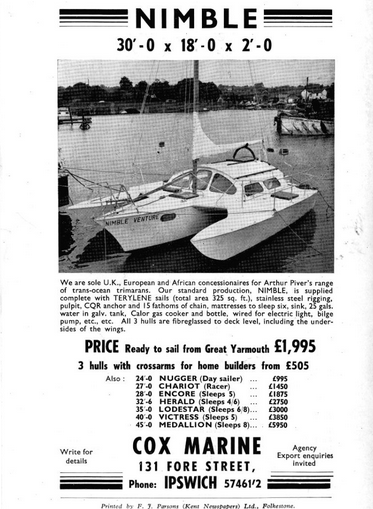
Yesterday while perusing boats for sale in the PNW I saw a Piver Nugget going for not a lot of money. I always liked the look of the Nugget but will be the first to admit it's a bit small for cruising.

That said, its big sister the Nimble would still make an excellent small cruising multihull.


Listening to some Christopher Cross coverage

So it goes...

Thursday, September 02, 2021

An interesting Tri...

On the subject of getting away with murder, some needful situational awareness, and in the "Dealing with bad/scary news" department......

While the available headroom might be a little tight for someone who's 6' 5" there's a whole lot of cool design in the Tricat 30.

 
Listening to too many dead  musicians

So it goes...

Friday, August 13, 2021

A quick update in case you have not been paying attention, some bad news on the Covid front, and a different way of collecting hurricane data...

Today I was looking an interesting "cruiser/racer" trailerable trimaran and something bothered me. Actually, the thing is, I tend to get bothered whenever I look at most multihull designs because almost always there seems to be some contradictory logic involved in the mix.

The logic works something like this...

Multihulls are light (with the notable exception of condomarans) and since they're light they are faster than comparable monohulls. Now, admittedly, that's a gross over-simplification but it is mostly correct. 

With me so far? 

So, here's the question: Why does the 8.5 meter (27-feet and change) trimaran I'm looking at sport a working sail area of 59 square meters (635 sq feet)?

More on the subject soonish.

Listening to Rickie Lee Jones

So it goes...

Friday, February 05, 2021

a few thoughts on the whole bigger and more complex is better mindset...

An excellent argument for the use of vaccines, some wage theft fuckery, and some very good news for Puerto Rico...

Not too long ago looking at various multihull plans I had a moment of realization that I haven't seen a new smaller design in ages. Every new "cruising" multihull I've come across is of the bigger is better sort. More cabins, fore and aft cockpits, bridgedeck flybridges, and a whole lot more complexity. 

Bigger and more complex is always going to be more expensive and the last word I want associated with any cruising boat I'd consider is the word "complex".

Now, the word "simple" when associated with a potential cruising boat has me salivating like one of Pavlog's dogs. Simplifying a product happens to be what used to be an evolutionary step in the design process along with making things more affordable and compact (if you need an example just think computers). Sadly, at least where boat design is concerned, it's just the opposite.

In spite of appearances, I don't really wear rose-colored-glasses when looking at older designs although I do appreciate the fact that most older designs were purposed more for cruising rather than charter. Still, most older designs could use some serious improvements because there really have been a lot of advances in boatbuilding during the last couple of decades.

For instance, as much as I like Jim Brown's trimarans or Wharram's catamarans I have to keep in mind that construction methods and materials have improved and, just maybe, taking the basic design and bringing it into the current century might not be a bad thing. Even better is the idea that one might also be able to make a less expensive greener boat with a smaller carbon footprint while you're doing it.

Now, wouldn't that be some kind of progress.

More on the subject soon come.

Listening to ten songs on a paradisaical theme

So it goes...

Saturday, January 30, 2021

On the subject of cruising and charter design...

A question of note, an interesting charting method, and in the "seriously creepy" department...

So, what do we actually want a cruising boat to be?

Think about that for a minute or two... 

A good cruising boat is a nomadic habitat that can take you pretty much anywhere in the world accessible by water. You want it to be safe, comfortable, and as trouble-free as possible. It should also be easy to maintain and operable within its crew's physical and financial abilities or constraints.

A good charter boat, on the other hand, is designed to generate income and that's the bottom line. Which, I'll be the first to admit, is no bad thing but making money creates a completely different design brief than you'd want for a cruising boat.

One of the things that still surprises me is that 90% of our crewed charter clients don't sail, they're not into boats, and, if anything, the whole idea of a sailing vacation does not quite track with them. What does track however is they like the idea of a movable luxury hotel room that moves from location to location with their own personal Chef and crew to take care of them. The newer the boat, ensuite heads, lots of toys, all creature comforts, and a killer menu is more often than not why people choose the boats they do.  Sure, they want the boat to look great but to most clients anything that's expensive and floats right side up is considered a great looking boat.

Charter cats are all built to a cost point as most charter boats are only built with a five year lifespan factored into the mix. Term charter (crewed boats) tend to last longer as they don't get the abuse that bareboats do but a seven-year old crewed charter boat is considered too long in the tooth to get top dollar. The point being that longevity is not a high priority on the design brief.

Most catamarans are sold to the various charter companies and, as such, most cats for sale are designed for charter. That equals a lot of catamarans. So many in fact, that you'll find very few manufacturers willing to start building a non-charter oriented multihull. Sure there are a few exceptions coming from small or boutique builders (Gemini comes to mind). 

How to tell the difference between a cat designed for cruising or a cat designed for charter? If the boat sleeps ten and has four heads it's a charter design.

Like I said before, I like term charter boats and have a business that is part of that industry so I understand why they're designed the way they are. The downside where cruising is concerned is that there are just not enough people buying new cruising multihulls for the boat building companies to design and tool up for, in their view, what they consider a minuscule market.

Since we're on a roll we'll talk about what I'd like a cruising cat to be in 2021 in the next post.

Listening to Margo Timmins

So it goes...

Support BoatBits

Friday, January 29, 2021

Some more on the multihull subject...

An interesting ongoing story, a TED talk about coffee, and the word of the day is A-N-O-C-R-A-C-Y...

Back in the early 80s when I was building a Wharram Tiki 31 in Port Marly France, magazines like Cruising World were running editorials proclaiming that catamarans were both unfit and unsafe as cruising boats. Just about everyone I knew counseled me on the dangers that catamarans represented and pointed out that cruising a cat would end in tears or death which made for some very short conversations on boatbuilding and design.

Not to toot my own horn but I knew better. A decade before, as a starving art student living on a boat in Sausalito and working part time putting interiors in ferrocement boats, I'd seen a couple of Piver trimarans sailing in all kinds of weather and showing their transoms to many of the "HOT" Bay racing boats. They were light, easy to build, cheap, and could get by with less sail area and still sustain higher speeds. To put it mildly they caught my attention.

Of course, at the same time over in the UK, catamarans were already an established part of the sailing scene with the Prouts, Lacks, Pat Patterson, Wharram, and MacAlpine-Downie building a multihull niche for normal folks. As a result there was ample information that multihulls were actually safe and sane as opposed to the entrenched opinion in the US of A that multihulls were a death trap and a possible killer of profits for US boat builders.

How the US sailing industry came to make a 180 degree shift to embrace multihulls is based more on the fact that the various companies selling bareboat and term charters realized that cats were a pretty optimum craft for chartering and, as they could sell a lot more charters with them, it was time to jump on the multihull bandwagon. Confronted with huge wads of advertising cash from the charter companies it seemed like an excellent time for the yachting whores press to do an about face.

The downside of all this is that what makes a good boat for chartering doesn't necessarily make a good cruising boat. As someone who has a charter company (by the way, even in these times of Covid, people can still charter in the Caribbean), and a couple of decades of experience within the charter business there is some basis to my opinion. Which is not to say that multihulls can't be great cruising boats but the design brief for a good cruising multihull is a whole lot different than for a charter multihull.

Next up we'll talk about those differences.

Listening to Kid Congo & The Pink Monkey Birds

So it goes...

Support BoatBits

Wednesday, January 27, 2021

On why I don't write more about multihulls...

Some poetry of note, on cruising in a Covid world, and something from Dick Dorworth's back catalog...

The other day someone questioned why I was so anti-multihull. A sentiment that always surprises me because I really love multihulls and I'd love to write more on new interesting affordable catamaran, trimaran, and proa designs.

The thing is, interesting and affordable multihull designs are as rare as hens teeth. For instance, Paul Bieker's B53 catamaran is all kinds of interesting but it's not a design I could afford to build or maintain and I know very few people who could.

Most production cats (or should I condomarans) I come across are of the same old same design brief that seems to have most owners using them as motorsailers if they sail at all. The truth is that multihull design suffers from the fact that it's the nature of multihulls to be weight sensitive and the accommodation that is currently fashionable inhibits performance which adds up to a problematic equation.

Made worse, of course, as most folk attracted to multihulls these days are more interested in creature comforts rather than performance. A situation that adds on the poundage to the point where it is no longer a surprise to sail past boat with immersed bridgedecks.

So, if anyone is aware of any interesting multihull designs being developed by some unknown designers out there do drop me a line because I'd really like to see some interesting boats to write about.

Listening to Admiral Fallow

So it goes...

Saturday, April 07, 2018

Interesting plywood...

An article in GQ you may want to check out, some interesting reading, and a President who actually makes sense...

A trimaran design of interest.


More information on this 14 meter trimaran design by Patrick Balta can be found here.

Listening to Väsen

So it goes...

Tuesday, March 20, 2018

and in the "Parker gets it right" department...

EBM points to a trend of import, some scary science, and G&T with a few interesting questions...

Yep, it's a trimaran and designed by Reuel Parker.


It's also a pretty neat boat and if I were thinking of building a trimaran I'd be all over it...

That said, Parker really deserves a gold star for listing an honest payload of 2500 pounds and spells it out for the design which is the sort of thing any designer of multihulls should do as standard operating procedure but few actually do.

Listening to Nilsson

So it goes...

Monday, March 19, 2018

sharpie meets tri...

A children's book in aid of a good cause, some needful reading, and Bureau of Land Management hijinks...

So, what have we here?


More about it tomorrow.

Listening to Guantanamo Baywatch

So it goes...

Saturday, August 03, 2013

GIGO...

One of the scariest things I've read in years, a needful lexicon, and it's getting pretty hard to respect any government agency these days...

Do you know what I find frustrating?

All those so-called truths that aren't really... Like schooners or gaff rigs can't sail to windward, deep draft is more seaworthy than shallow draft, and multihulls don't sink.

The thing is, that like most things, it often depends and, more often than not, gross generalizations often tend to bite you on the ass if you're not careful.

Take the whole multihulls might capsize but they won't sink urban legend... Sure, a catamaran or trimaran does not have tons of lead but the lack of ballast is no cure for sinking unless the boat has positive buoyancy...

The real question is does a given cat or tri have positive buoyancy and how much? The answer is it all depends.

Sadly the question is a lot harder to answer than you'd expect... A wood or wood composite cat/tri you can pretty much expect it to float because wood floats.

Fiberglass, on the other hand, might or might not. Solid fiberglass pretty much sinks like a stone but some glass composites of the foam core variety will float while others don't and it mainly depends on the glass to foam ratio in the layup. Which is why next time you find yourself cutting a hole for yet another thru-hull you might want to throw the resulting fiberglass disc in the water and see what happens...

It gets worse. Even if your hulls have some positive buoyancy, all that stuff aboard you can't live without and various needful systems tend to add up quickly and, for want of a better word, becomes ballast. I think it's safe to say we all know what too much ballast does to positive buoyancy!

So, some multihulls don't sink and some will because the lack of ballast is not the only factor you're dealing with. Of course, like all good myths there's always a seed of truth somewhere in the mix. When the first claims of multihull superiority (think Wharram/Piver days) were being tried out almost all multihulls were wood and glass and did not sink...

Personally, I don't think being unsinkable is all that important (hey, I still think ferro-cement is a great material to build boats with) but I'd sure want to know just where my boat stood on the whole buoyancy factor whether it was a monohull or a multihull.

Listening to Richard Thompson

So it goes...

Wednesday, December 19, 2012

It's the price dude...

Just a quick glimpse of the near future, a quick reality check, and Ian Welsh touches on why a lot of folks are out cruising...

Yesterday's mailbag was sorta interesting so maybe a good time to set the record straight.

First of all, I like multihulls. Sure, I'm somewhat critical of a lot of modern low bridgedeck multihulls fobbed off on an unsuspecting public but, on the whole, I think multihulls make all kinds of sense when they are designed right.

The fact that I simply don't think they make sense for someone making $15 an hour is simply based on the sobering reality that multihulls are just more expensive than someone working as a line cook at Denny's can afford. Face it, when all is said and done, used monohulls have way more bang for the buck...

Which brings us to Wharram, Brown, and Piver. I was not being sarcastic, what I was doing was pointing out that just about the only bargains around in multihulls are boats designed by these three fellows. The reason you can find them for a semi-reasonable price is that a lot of folks built their designs, used them hard, and a lot of them are not in exactly pristine shape. For the record, I can't think of many boats more suited to the whole VolksCruiser lifestyle than a Brown SeaRunner, Wharram Tangaroa or a Piver (well to be honest, a Piver where the builder actually followed the plans)... That said, most used Wharrams, SeaRunners, and even Piver boats in decent shape sell for more than the Volkscruiser can afford.


Listening to Warren Zevon

So it goes...

Tuesday, December 18, 2012

and about those multihulls...

Bill making some pretty good points, L,G,& M point out some stupid ones, and a place where no guns are needed...

Yeah, what about multihulls in the whole VolksCruiser universe?

Problematic at best as multihulls are just silly expensive. I see old Piver and Jim Brown trimarans at reasonable prices that make sense from time to time, the odd Wharram or other cat home-built with issues. To be truthful, on a VolksCruiser budget, multihulls are never going to be your first or even second choice.

Listening to Ezra Furman & the Harpoons

So it goes...